Art Engine :
SPECULATIVE BRAND ENGINE


He works in a field that does not quite have a name yet. At the crossroads of art, design, research, and fabrication, he creates forms that make visible the ways contemporary technologies slowly enter and reshape our intimacy, our imaginations, and our behaviors. His work lives in that unsettled space where the machine no longer merely produces, but begins to influence our emotions, our gestures, our desires, and the inner narratives through which we make sense of ourselves.
A French artist based between Paris and Brooklyn, he develops a transdisciplinary practice spanning installation, image-making, electronics, artificial intelligence, sculpture, print, and hybrid devices. His work explores the tensions between living systems and infrastructure, craft and automation, body and interface, identity and simulation, bringing code, plant life, matter, and symbolism into charged relation.
His visual and material language grows out of an ongoing reflection on emerging forms of creolization between living beings, data, images, subjectivities, and technical systems. More than a critique of technology from the outside, his work gives shape to the ways it is already moving through us: through our sensibilities, our attachments, our projections, and our ways of inhabiting the world.
Text written in the context of the Fondation de France Prize.
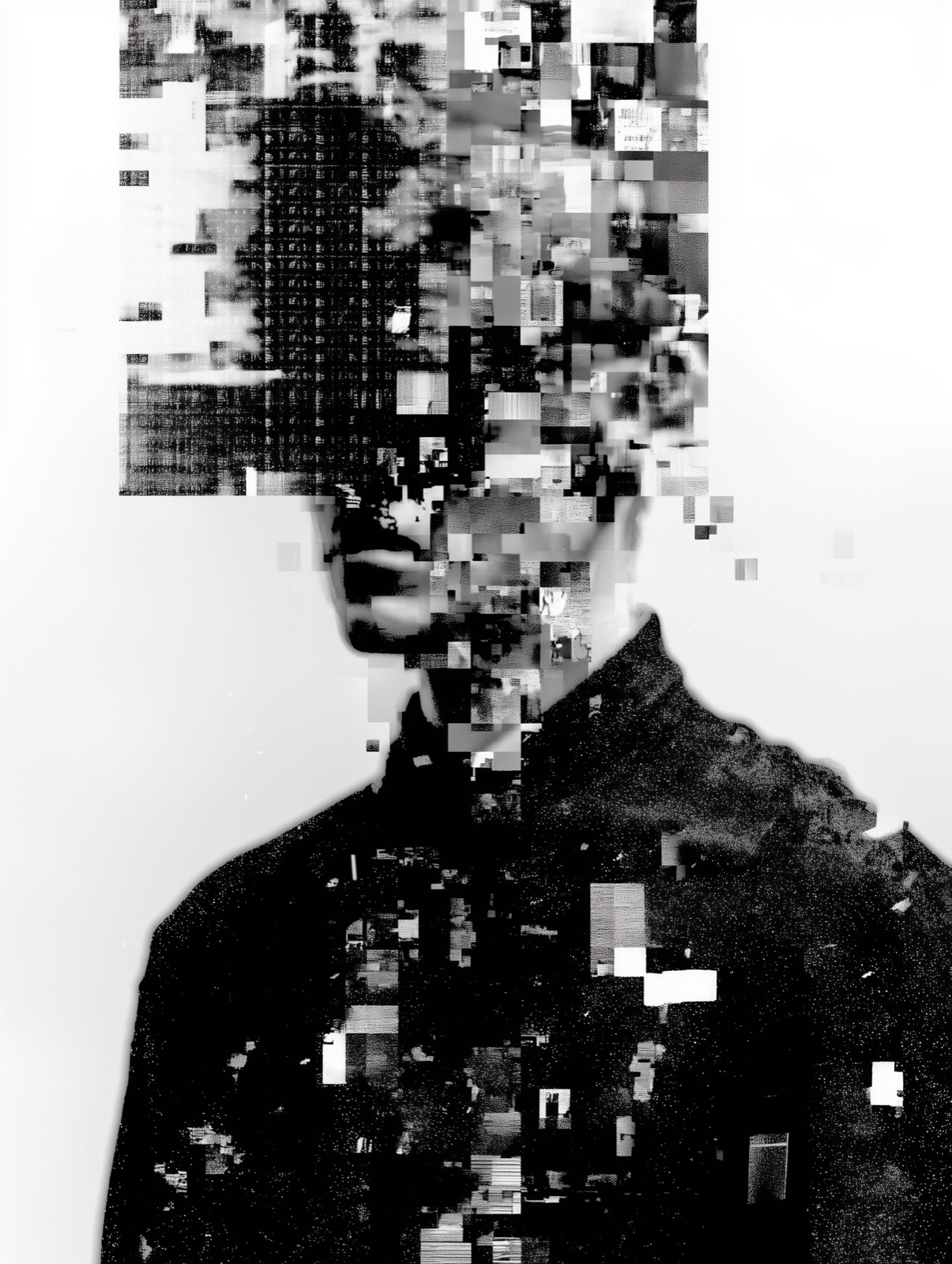
He works in a field that does not quite have a name yet. At the crossroads of art, design, research, and fabrication, he creates forms that make visible the ways contemporary technologies slowly enter and reshape our intimacy, our imaginations, and our behaviors. His work lives in that unsettled space where the machine no longer merely produces, but begins to influence our emotions, our gestures, our desires, and the inner narratives through which we make sense of ourselves.
A French artist based between Paris and Brooklyn, he develops a transdisciplinary practice spanning installation, image-making, electronics, artificial intelligence, sculpture, print, and hybrid devices. His work explores the tensions between living systems and infrastructure, craft and automation, body and interface, identity and simulation, bringing code, plant life, matter, and symbolism into charged relation.
His visual and material language grows out of an ongoing reflection on emerging forms of creolization between living beings, data, images, subjectivities, and technical systems. More than a critique of technology from the outside, his work gives shape to the ways it is already moving through us: through our sensibilities, our attachments, our projections, and our ways of inhabiting the world.
Text written in the context of the Fondation de France Prize.
Powerhouse Arts — Printmaking Residency
Coming soon
Upcoming residency in New York within Powerhouse Arts’ printmaking program.
Industry City Arts Program Residency
Ongoing
Residency currently underway in Brooklyn, New York.
NYC Makerspace Residency
Ongoing
Residency currently underway in New York, centered on making, research, and experimentation.
2026Powerhouse Arts, New York City 2025Selected SORA OpenAI (talented artist), New York City 2025Maker Space Program, Army Terminal, New York City 2024@Push, Sur l’envers, curated by Andréanne Béguin, Paris 2024Art in the Age of AI, Villa Albertine, invitation by Camille JeanJean, New York City 2023Industry City Group Show, New York City 2022Fondation Orange Rouge, Paris 2021Normal Map, Thomas Guillemet x Centre national édition art image (CNEAI), Paris 202165th Salon de Montrouge, Paris 2021Jeune Création 71, Fondation Fiminco, Paris 2020Skéomorphe, Île-de-France Art Center, Auvers-sur-Oise 2020I HAVE DONE THINGS HERE I COULDN’T DO ELSEWHERE, 6B, Paris 2020The Wrong Biennale, co-curated by Indira Béraud, international digital event 2020BodyFail, Institut Français, Abu Dhabi 2020European Night of Researchers, Quai des Savoirs, Toulouse 2019It Is Urgent That Progress Be Programmed, The Window, Paris 2019Coding the World, Centre Pompidou, Paris 2019The Gesture, CNEAI, performance / intervention, invitation by Julien Prévieux and Romain Semeteys, Magasins Généraux, Pantin 2018Entretiens de Royaumont, La Sorbonne Abu Dhabi, United Arab Emirates (Institut Français) 2018Pyramid of the Louvre, Paris (private Accenture evening) 2018Mutations/Creations: Coding the World, Centre Georges Pompidou, Paris 2018Lost in Translation, Galerie des Beaux-Arts, Paris, France 2018FILAF, International Festival of Art Book and Film, invitation by Romain Semeteys, Perpignan 2017Young Talented, Fondation de France, laureate, invitation by Yael Naim, Le Centquatre, Paris 2017Go Canny, Poetics of Sabotage, Villa Arson, invitation by Eric Mangion, Nice 2017Pulsar, Fondation EDF, Paris 2016A Future Unknown, Villa Emerige 2015—Dys—affordance, CDDA SVA, New York City, USA
2011 — 2015MFA Visual Arts & Fine ArtsÉcole Nationale Supérieure des Arts Décoratifs — Énsad —, ParisValedictorian, jury president José-Manuel GonçalvèsVisit 2013 — 2014Bachelor Visual Arts & Fine ArtsSchool of Visual Arts — SVA —, New York CityGPA: 4.0Visit 2013 — 2014Type@Cooper, Typeface design.The Cooper Union, New York CityVisit 2009 — 2011Bachelor Visual Arts & Fine ArtsÉcole Estienne ÉSAIG, ParisÉcole Supérieure des Arts et des Industries GraphiquesVisit
PROFESSOR-RESEARCHERVisual arts, speculative design and strange design, experimental design, type design
Teaching across several master’s-level programs:—MFA— Global Design, Research & Innovation—MFA— Art Direction in Design—MFA— Fine Art & Visual Arts—BFA— Fine Art & Visual Arts
Teaching:— Visual arts & printmaking, mixed media, Art Engine, typography, type design, editorial design, experimental design, speculative design— Critical advising, diploma-project supervision, and thesis direction— Curriculum and workshop programming
Partner institutions:— French Ministry of National Education / Académie de VersaillesArts, culture, and design education— École supérieure d’art et de design Condé, ParisMFA, BFA
Students mentored(MFA) thesis and final project
Alison RicoSite Arnaud KaltInstagram Aurélia Fabre Aurélien CattinSite Camila Ramirez Camille BourdonSite Camille ChanudetInstagram Dylan Da SilvaSite Juliette CavrotSite Léo ImbertSite Mélanie Mercuri Mirei SugimachiSite Pauline GueriniInstagram Pauline HA-FAInstagram Pierre-Ange AznarSite Pierre CottoInstagram Swann VazeuxInstagram 1 Instagram 2 Valentin JabaudInstagram 1 Instagram 2 Victor MontetSite Yohan Rihouay Zhi Bin YuInstagram Zoé Le Corre
IRRESISTIBLE
The machine put to the test of desire
Salon de Montrouge, October 30, 2021. I am hailed by a few words, “SEND NUDES, I’M SAD,” spelled out in capital letters on backlit panels, artisanal light boxes. It is the section of the Salon reserved for Thomas Guillemet, overloaded with objects: screens, images lit by neon, and assemblages of ceramic, cord, and latex cover prints glued across the entire surface of the walls. Some borrow their curves and dimensions from sex toys, others from BDSM accessories. One of the screens loops a futuristic animation containing a phone number, to which one can send a text in order to begin a conversation with an artificial intelligence. Whether physically present, modeled in 3D, or photographed, the different elements are caught in complex entanglement, much like the interlacing leather straps that emerge from and return into the mouth of one of the masks on view.
A few months later, I find those same objects in Thomas’s studio in Auvers-sur-Oise. I needed to dig deeper into the conversation we had begun at the Salon, one that had seemed to conceal a richer and more complex practice. Also because Thomas’s work resonated with me on several levels: questions of art and science, but also of the digital and sexualities, were present there and treated in a singular way, nourished by a sustained process of research.
At the crossroads of all these flows
It is with all this in mind that I entered, one day in February, this studio tucked beneath the eaves of an artist’s residence, lit by a vast skylight. Beams run through the space and everything is painted white. Dozens of ceramics are arranged on a table in the center, while leather scraps hang over one of the beams alongside various lengths of rope. I recognize the panels from the latest installation, dismembered and distributed to the four corners of the room. Stoneware slabs lean one against another on the floor, while others whose surfaces have been printed rest on a workbench set slightly apart. In one corner, just where the sloping ceiling forces one to bend down, a plotter. Opposite, Thomas is unpacking more wrapped ceramics, and we begin to talk.
Surrounded by these accumulations of matter, he explains his way of working. A long process of assimilation leads to the formation of these hybrid objects, both in their forms and in their materials. The young artist has paid close attention to what takes place on the internet. He has combed through pornographic websites and forums, whether gaming communities or sex-work exchanges, and has at times even entered into anonymous conversations. He developed a genuine interest in what he might call the “mutations of erotic desire,” in neoporno. His work situates itself precisely at the intersection of all these flows, most of them digital, which he absorbs and from which he brings forth chimerical models and assemblages.
In order to create these new forms, Thomas draws on the way sex toys are designed, on their relation to anatomical mechanics, and makes use of many codes from the pornographic sphere. The letters 4K and VR, for example, cite the way pornographic videos are indexed, a sign of an increasingly technological relation to eroticism. ASMR, meanwhile, reappears in curtains of fake nails, patiently assembled by Thomas, also symbolizing the precise point of contact between body and screen. Finally, the rose emoji used on escort sites as a metaphor for a mode of payment is incarnated by petals fixed in the epoxy resin of certain parts of the installation.
All these examples bring SEND NUDES, I’M SAD close to what might be the aesthetic rendering of a sociological observation of contemporary sexualities. A biased rendering, however, because the objects are diverted, made inoperative. It is hard, in effect, to imagine actually using these sex toys, given their fragility or their complex forms. Yet what is striking in Thomas’s practice is the repeated effort that converges toward material creation. There is, indeed, the desire to give presence to latent phenomena, to perform this translation from the digital into matter. Thomas claims an artisanal protocol of creation, one that fully takes the time matter requires and that he carries out for the most part alone, with his hands. The point is to incorporate an artisanal value into his works, to preserve the possibility that things might remain imperfect, in opposition to a technological mode of making that would tend instead toward perfection.
A resistant relation
That long structured Thomas’s relation to the machine. In the first years of his practice, he maintained a conflictual bond with it. Whether in print processes, digital work, or language, many of his earlier projects emphasized sabotage, such as the Dysfordance series (2014–2021), at the origin of the graphics for the exhibition Go Canny! at Villa Arson in 2017, or the implementation of strategies of micro-resistance, as in the project Bored At Work presented at CNEAI.
Other installations highlighted the incoherence and absurdity of digital technologies, such as It Is Urgent That Progress Be Programmed (2019), which involved a generator of meaningless sentences based on facial recognition. Thomas Guillemet also explored other means of producing mechanical resistance to the machine, notably through off-register print processes recurring in many of his installations, drawing on Wade Guyton’s glitch aesthetic and reintroducing a sense of physicality.
All of these strategies, developed and tested through the artist’s dispositifs, were in some way motivated by a fear of machines, and especially by the fear of becoming one oneself. This is one reason why Thomas’s practice often manifests a desire to deceive, or at least to encrypt, messages so as to divert them from automatic, instantaneous comprehension. This is precisely the point of the ongoing series Bot or not to bot (2014–2021), a compilation of prints present in each of the artist’s installations, on which CAPTCHA-inspired motifs overlap one another until they become illegible, as a way of preventing the works from being too easily accessible and once again asserting resistance.
Building a capacity for adaptation
Yet Thomas’s most recent installations, including SEND NUDES, I’M SAD, seem almost the opposite of resistance. They might even suggest a form of surrender. By largely integrating the notion of desire, Thomas now leads a body of work that nourishes, and even amplifies, the possibility of complementarity with the machine, if not outright hybridization. What I find especially compelling is that it is precisely when Thomas begins to take practices of desire into account that he manages to construct a capacity for adaptation and to propose formalizations of it. In this, his work joins philosophical theories that define desire as a transformative energy.
It is also necessarily through a more carnal approach that the possibility of mutation emerges. If the question of the human had always been present in Thomas’s obsessions, it appeared there only in the negative, as a dichotomous opposition to the machine. Now the relation to the body is far more fully assumed, and the search for hybridity unrestrained. Thomas confided to me that one of his current lines of formal research, in order to continue in this direction, would be to create a fantasized robotic-erotic, even pornographic form with no human or anatomical referent at all. This aligns with the idea of transmachinism that he defends, a notion related to but opposed to transhumanism, insofar as it means accepting that the machine preexists us, and therefore choosing to adapt ourselves to it rather than vainly attempting to surpass human faculties.
What is also rich in Thomas Guillemet’s work is that we find ourselves exploring territories not so far from those described by Donna Haraway, but by way of the machine rather than necessarily from a feminist standpoint. The way Thomas addresses these issues is therefore resolutely contemporary, because his relation to the digital inevitably also engages a relation to gender. His work is itself hybrid. It seems to me particularly compelling, from a critical point of view, to observe a young contemporary artist primarily interested in the digital now shifting toward questions of gender and sexuality.
Perhaps a revolution has taken place
This marks our contemporary moment, within which discursive porosity has perhaps become more evident. Thomas, now thirty-two, has himself come into contact with such discourses through his research, which has also led him to testify to the ordinary relation newer generations maintain with the mixing of desire and technology. We ended our discussion by evoking Gen Z’s relation to virtuality and its much more evident propensity for mutation.
Indeed, perhaps a revolution has taken place over the last ten or fifteen years. That is, from an open-source internet that promised both total freedom and self-invention, one Thomas regrets and which also formed the core of the exhibition I Have Done Things Here I Couldn’t Do Elsewhere, which he curated in 2019 at 6B, perhaps we moved into an internet governed by regulation and formal identity, only to arrive today at a metaverse paradigm, no doubt capable of redefining on a large scale what relation to self means and of recalibrating modes of hybridization with the machine.
What we therefore see is a succession of moments of resistance and adaptation between the human and the machine, which Thomas’s practice, in contact with the most contemporary discourses, translates particularly well. Next, the young artist will turn to climate change and the environment, through a project for the United States. The idea will be to make American data centers interact with the surrounding botanical milieu, through an extended process of research and information gathering.
Creole Robots
While our daily lives seem to be codified by algorithms, the body’s materiality goes off the rails, bursts through, exceeds. In the shadows of the internet, office workers organize championships in pen spinning, chair spinning, or hand drumming. Thomas Guillemet inventories these gestures of resistance to bureaucratic conditioning. One must be prepared to put on sunglasses, almost angrily, in order to read the encrypted neon sign NSFW (Not Safe For Work). The artist tracks the dissonances between the exponential power of machines and our bodies’ remarkable capacity for malfunction. Our lives are a glitch in the system. “My dyslexia led me toward printed language, which I could manipulate: what I had not mastered became a way of escaping the meaning of words,” the artist notes. When he prints CAPTCHAs, those encrypted words illegible to robots, onto domestic materials such as carpets or corrugated metal, he foregrounds a paradox: it is typography, this old technology, that still enables us to distinguish a human from a virus. He prints on these surfaces the threatening names of spyware and malware so that his works themselves might infiltrate the network while masking their identification as art. For the artist, it is our capacity to understand error and to imagine that distinguishes us from artificial intelligence. He therefore hacks robots sensitive to human movement by choreographing forms of sabotage. Though we believe we are creating objects, they are in fact acting upon us, conditioning our gestures: the artist critiques this principle of affordance, an object’s capacity to suggest a use, by touching or eroticizing objects, recalling through misuse the arbitrariness of their ergonomics. “Growing up in the Parisian suburbs allowed me to grasp very early on that mutations in language are also mutations in society,” he recalls. “Technology-specific language becomes human behavior.” When he inscribes Netflix and chill, a millennial synonym for hooking up, onto ceramics, older oppositions between real and virtual, body and machine, also become archaeological.
Contemporary Realities
Edition No. 2192
Thomas Guillemet finds the substance of his work in the arcana of software, artificial intelligence, and surveillance systems. Born in 1989 and trained at the École Nationale Supérieure des Arts Décoratifs in Paris as well as the School of Visual Arts in New York, the artist observes the mutations of our language, our behaviors, and our desires as they are reshaped by new technologies. Dyslexic, he first became interested in CAPTCHA typefaces, those encrypted identifiers designed to distinguish a human user from a computer virus, before creating wild choreographies that elude recognition cameras. Drawing on both artisanal and digital techniques, his works bring together typography, print, engraving, and ceramics with interactive dispositifs, as in the striking multimedia installation he presented in June at Jeune Création. His project for Montrouge extends that same line of inquiry through an analysis of the codes of online neo-porno: the evolution of keywords, image quality, and filters; the gamification of viewpoints; and the gadgetization of sex toys, here embodied by remarkable BDSM leather masks designed from facial-recognition models.
Conditioned Desires
The desire put to the test by code
In his latest piece, Il faudrait que je cessasse de vivre pour cesser de vous aimer (I would have to stop living in order to stop loving you), Thomas Guillemet continues the research he has pursued since his earliest works: an inquiry into the mutations in our behaviors brought about by technology. In this new work, it is neopornography and its practices that the artist explores, confronting and questioning our relation to these images, and the way technology shapes and transforms desire itself. Thomas Guillemet welcomed us into his studio in Auvers-sur-Oise. This interview is the result of a fascinating exchange on the peculiar spectacle of pornography, in the course of which we discussed visual obsession, the erotic landscape, code and encryption, critical design, the structure of our digital lives, and the links forged between technology, body, drives, and affects.
Last October, Thomas Guillemet presented, for the 2021 edition of the Salon de Montrouge, the installation Il faudrait que je cessasse de vivre pour cesser de vous aimer. The installation takes the form of a small clinic of sexual desire, made up of black leather, metal, neon, erotic accessories, and drawings of liquid, curving forms. A certain frenzy emanates from it, something like a feverish vision. Il faudrait que je cessasse de vivre pour cesser de vous aimer is a coded surface with a rather dark aesthetic, composed of objects of uncertain status and words in suspension: “Send nudes I’m sad,” “Boy bot anale intense 4K 60 FPS VR.” These inscriptions mingle the description of technology with that of sexual desire, replaying the logic of tags and categories found on pornographic websites. Structure and feeling. The whole blurs and absorbs the identification of each object, at least at first glance, as though something there were encrypted. There is a very clear seduction in this piece, through the very theme of the objects it displays. At the same time, there is something almost refractory to it, something harsh, that holds the viewer at a distance. The eye does not enter it easily. This is due both to the number of proliferating objects that compose the installation and to the graphic surface that interrupts reading and complicates legibility. In the end, this work appears as the site of a code, of a complexity, one that this interview proposes to take the time to understand and analyze.
Not Safe For Work — NSFW
The artist
Thomas Guillemet, born in 1989, is an artist based between Auvers-sur-Oise, Paris, and soon New York. He works on the mutations of behavior and language brought about by technical and technological developments. His practice most often takes multiple forms, combining traditional media and artisanal know-how with technology in order to describe the intangible nature of digital creolization. His favored techniques include engraving, ceramics, weaving, printmaking, set in contrast with 3D modeling, augmented photography, programming, digital printing, and more. His two most recent research trajectories are “the mutation of desire,” through neoporno, and the Dataflower, through meta-botany.
The project
Thomas Guillemet invited the students of Jules Michelet middle school (Saint-Ouen, Seine-Saint-Denis) to explore the communities of the internet through their own belonging to this new generation. Three temporalities and actions were articulated throughout the project: a phase of research in order to gather and collect archives of the various mutations in behavior and language brought about by recent technologies, and in particular “gestures of deconcentration”; a second phase devoted to the creation of a new technological medium through the design of a robotized drawing machine that imitates human drawing and gesture; and a final phase centered on the making of tribal masks designed to foil facial-recognition grids through tribal patterns.
A Future Unknown
“At first contact with his works, one feels a kind of irreverent ardor, as if one were in the presence of an energy emancipated from good behavior. Thomas the artist seems comparable to an autonomous machine, one that would dictate its own aesthetic rules while playing with every fashionable use. He engraves, he draws, he paints, or at least applies paint to a support, he glues, and at times he sculpts. Through accumulations of large formats that somehow never exhaust our attention, this young man works a little in the manner of an old master, using every tool in his environment, from the most traditional to the most avant-garde. Among the techniques he develops, one consists in diverting the Kinect peripheral, the infrared sensor of the Xbox console, allowing him to record his movements in space. These gestures are then transferred into software they themselves developed, which translates them into a graphic equivalent made of points. The resulting forms are then printed in large format with a plotter, serving as the basis for a composition that he subsequently reworks. This ‘augmentation’ of a printed image is a process he uses often. In the Dazzle Pixel series (2016), he reproduces forms used by hackers to encrypt typography against surveillance computers. Thomas uses these motifs as the basis of his images, with a common denominator: the square, more precisely the pixel, which for him is ‘the fundamental form of our generation.’ In his experiments, he also uses ordinary objects, which should almost never cross paths with a sheet of paper: a computer keyboard, a bicycle wheel or pedal, a ping-pong table... In his hands, they become playful, graphic tools that ‘complete’ the work by plunging it into unpredictability: compositions spin out, rhythms emerge, spaces are hollowed out, surfaces skid, like an abecedary of all that can be done in width and height. There is something of primitive pleasure flourishing here and remaining inscribed in the image: a place one thought exhausted, where adventure begins again.” — Gaël Charbau, Une Inconnue d’avance Révélation — Emerige — Les Éditions Particules, 2016
Artist Statement
“Olivier Alexanian, with whom I formed a duo, moved into politics. Today, working solo, I continue to collaborate regularly with artists, but also with scientists and engineers. Together, we attempt to speak the same language, to initiate dialogues with the machine, and to see through its eyes. My approach is not to open a machine’s black box but to engage with it as one would with a person, even a loved one. If the machine is commonly the receptacle of fantasies and anxieties, I seek, for my part, to anthropomorphize it. I therefore situate myself on the side of trans-machinism, the augmentation of the machine by the human, and against transhumanism. I aim to short-circuit and bypass the fixed systems established by engineers. To do so, I apply the idea of disorder to the pragmatic and rigorous architecture of machines by creating disturbing situations that I call dys_affordances. ‘Dys’ signifies disorder, while ‘affordance’ refers to an object’s capacity to suggest its use. A machine is not more human when it makes no errors, but when it commits subtler ones and generates unexpected events. By pushing the machine to its limits, my work appropriates it precisely by creating inappropriate forms. I like to define this as a poetics of sabotage. Conceived with programmer Clément Barbisan and choreographer Jean-Marc Matos, the project BodyFail focuses on the processes through which the body introduces error into the machine. A neural system is supposed to recognize bodily positions, yet some of them make it bug. We therefore took inventory of them and composed scores of error. My work revolves, in fact, around an exploration of language. This is probably linked to my dyslexia. I make interpretive mistakes constantly, and these sustain my research, allowing me to question what constitutes a norm by celebrating what departs from it.”
Work in promess
The slash, that typographic sign of the slasher, seems indispensable for approaching the work, or rather the works, of Thomas Guillemet. Graphic designer / artist / designer / researcher /... like those modern young workers who move from one job to another all at once, Thomas Guillemet is a kind of innovative enterprise all by himself. A startup founder without a market and without profitability, whose R&D is grounded in interactions between human and machine, in their zones of misunderstanding and discomfort, in the faults that lead inevitably to miscommunication. A deliberately disordered thinker, close to the class of hackers and to the open source movement, Thomas Guillemet pursues a self-proclaimed mission of de-standardizing graphic elements deemed inappropriate: crossings-out, scribbles, reversals, degradations. The aesthetics of failure allow him to be audacious, to create a broken visual rhythm that forces shifts in point of view and perception. Gesture is of course central, always bound up with the use of a tool and a technique, whether artisanal, such as lithographic printing, or computational, such as binary code, whose digital competencies will in turn become artisanal, in full respect for the traditions of future generations. All of this concerns disturbances across various bodily, dialectical, and affective dialogues in which the human body confronts the technological body, typographic signs are translated into digital signs, and emotions with machinery are never reciprocal. We do not understand one another; the profiles are incompatible. No point in swiping left, it won’t work.
As If the Body Were the Ultimate Resource
Admission to this exhibition is officially off-limits to robots. Thank you for your understanding. We are in a world of accelerated mutation, toward a future that is already obsolete. The robot has turned out to be more of a predator than a simple rival. Long gone are the days when certain people decided to bet on the machine rather than on humans, investing in a future shaped by cyclopean technology. Far from the aborted dreams of longevity, the outcome of research undertaken in the age of capitalism has brought about an unprecedented emergency: we are now in survival mode.
The question of the relationship humans generate and sustain with the machine is at the heart of Thomas Guillemet’s research in his exhibition Honda Accord 2000 V6. The work examines the possible modes of emancipation from, or coexistence with, the rise of technology. Upon entering the space, the visitor is struck by the artificial light emitted by neon signs. The acronym NSFW (Not Safe For Work), straight out of internet culture, appears there in unavoidable lettering.
On the walls, one encounters fragments of memory: images captured by Chatroulette users hidden behind their screens. Votive candles lit in honor of these contemporary relics immerse the viewer in a religious atmosphere tinged with nostalgia. Rugs and CAPTCHA prints covering the ground and walls secure the perimeter. CAPTCHA names a family of digital tests meant to distinguish humans from robots, for whom identity theft is commonplace. Presented in this manner, stripped of regional markers or words of welcome, they function as the kind of verification one expects from the digital landscape. This administrative checkpoint is not unlike a customs gate: situated between two spaces, gallery and street, it restricts access. Geographical borders, blurred by the digital revolution, have given way to a new kind of individual limitation. This frontier zone aims not to separate people according to origin, but to distinguish the living from the mechanical.
Once the boundary has been crossed, walls covered in emergency blankets reveal a post-apocalyptic universe. A cryptic inscription cynically announces one survivor: “Steve [Jobs] is OK”! We are all reassured. A small altar dedicated to the gods invites us to contemplate the treasures of the past: wax amulets and ceramics glorifying the GAFA giants. Silicon Valley, architect of a collective imaginary, visibly kept people under its spell. This archaeology of the future presents computer hardware of every kind in the guise of archaic ceremonial display. Worshipped because they embody the memory of past generations, these outdated tools testify to a bygone era. Deprived of use, only a brutally material form remains. Yet the dead object, through its endless process of decomposition, will outlive us.
Further inside the exhibition, sculptures rise within a post-human vegetal landscape. From the symbiosis between the human body and the automobile emerge hybrid works that are profoundly unsettling. Video projections animate car hoods. The bodily envelope, a true protective barrier whose cells ensure continuous regeneration, has become raw material for the machine. By overturning power hierarchies, these machines emancipate themselves from human oversight. The algorithm of self-driving cars, once able to decide for the passenger whether they should live or die, has reached its endpoint. If the body, as Nietzsche argued, is made of drives, desire, and instinct, and if without it the soul does not exist, then perhaps in this bodily quest the transmachinists will succeed in generating consciousness, and all that follows from it.
Nearby, a laser printer named Stuxnet sets itself to engraving the works. Like its namesake, the malware discovered in 2010 that targeted Iran’s nuclear program, the machine sabotages the site. Hacking is integrated into the creative process in order to propose an alternative version of preexisting works. Upstairs, a resistance cell.
Skeuomorphism, whose aim is to make the human-machine interface reassuring and pleasurable, consists in giving a virtual element the appearance and the name of a real object. Moving a document to the trash is ultimately only a cluster of lines of code. The sound piece extends the artist’s research into skeuomorphism. Played on a loop, a woman’s voice reveals the source code of the neural network developed for his installation BodyFail. Ones and zeros follow one another at a heartbeat rhythm, carrying the viewer to the very core of the digital organism. Here again, hierarchies are unsettled, since what is usually hidden is brought to the foreground, and what should be read is instead heard.
Just as one becomes aware of electricity when there is a blackout, the material nature of the digital is eclipsed by its now ordinary omnipresence. The tool’s tangible form disappears behind the use assigned to it. The engravings presented here are likewise made with reconfigured digital tools, so that only their material characteristics are exploited. The keyboard performs the work of a paintbrush in the making of the piece, what Thomas Guillemet calls a “positive decadence.” By deconsecrating the digital object, by dissociating the object from its function, he reclaims the use of the body. The tools that were supposed to free human beings from the assembly line ultimately forced them into repeating the same gestures. While the user slumps behind the screen, limiting the use of their limbs, the artist reintegrates into his creative process ancient modes of bodily production. In the final room of the exhibition, the installation BodyFail, subtitled “The body as the boundary of code,” invites the visitor to experiment with positions in order to elude video surveillance. By adopting deviant gestures, by playing with balance / imbalance, symmetry / asymmetry, alignment / misalignment, focus / defocus, one may cause the machine to glitch. Each time a visitor manages to do so, the pose is added to a score of movements deemed defective.
As if the body were the ultimate resource.
Body in Play
Thomas is a young artist of unwavering determination. Dyslexic, he nevertheless pursued a brilliant course of study, graduating top of his class with highest honors from the jury of the École des Arts Décoratifs in Paris. His artistic practice questions the widespread use of new technologies and the relation between the digital tool, conceptual art, and the worlds of craft. Beyond performance, often documented on video and circulated on YouTube, Thomas Guillemet develops critical propositions around technology and its uses.
His project is to develop an interface capable of translating gesture, potentially that of a dancer, onto the machine of a master engraver, thanks to the détournement of a now well-known video-game sensor: the Kinect. Between artistic creation and philosophical inquiry, Thomas’s project brings to light the growing proximity between the digital and the human.
Olivier Alexanian, Jean-Marc Matos, Clément Barbisan, Laurent Lacotte, Indira Béraud, Yoan Rihouay, Dylan Da Silva, Pierre-Ange Aznar, Christian Joseph, Jocelyne Maillard, Nahtalie Desmet, Marion Zilio, Eric Mangion, Cris Gianakos, Pauline Lavergne, Patricia Folgringer, Romain Semeteys, Camille JeanJean, Lionel Hager, EnsAD de Paris, École de Condé Paris, Gaël Charbau, Pulsar The Art Prize, Alix Debussche, Oihana Ospital, Sylvie Boulanger, Andréanne Béguin, Corinne Digard, Théo Diers, and Hélène Soumaré.
Institutions: EnsAD de Paris, School of Visual Arts, The Cooper Union, École Estienne, École supérieure d’art et de design Condé, French Ministry of National Education, Académie de Versailles, DRAC Île-de-France, FRAC Occitanie, Fondation de France, Fondation Fiminco, Fondation Orange Rouge, CNEAI, Centre d’Art d’Île-de-France, Institut Français, Quai des Savoirs, Poush, Villa Albertine, Industry City, NYC Makerspace, 6B, Jeune Création, Salon de Montrouge, The Window, Centre Pompidou, Centre Georges Pompidou, Magasins Généraux, La Sorbonne Abu Dhabi, Galerie des Beaux-Arts, Le Centquatre, Villa Arson, Fondation EDF, Villa Emerige, the Louvre, and Powerhouse Arts.
Orange RougeFoundation committed to access to artNot Safe For Work (NSFW)Project Orange Rouge
Arts and Cultural EducationFrench Ministry of National Education / Académie de Versailles
ART KIDS ParisFor access to art in underserved communitiesInstagram
Thomas Guillemetthomas.guillemet.two@gmail.com
FR +33 (0)6 48 37 06 88US +1 (347) 382-4891
TikTok
Studio & Workshop — PARISDRAC ResidencyAtelier 95 rue du Montcel95430 Auvers-sur-Oise
Studio & Workshop — NEW YORK CITYIndustry City67 35th StreetBrooklyn, NY 11232USA
LEGAL NOTICE
Site publisherThomas GuillemetBusiness address: 5 rue du Montcel, 95430 Auvers-sur-OiseContact: thomas [point] guillemet [point] tw [at] gmail [point] com
Publication directorThomas Guillemet
HostingOVH SAS2 rue Kellermann59100 Roubaix — FranceTel.: 1007